DUNTON DAYS
After moving to London, Leatherland and his family lived in a rented house at Elms Road, Clapham. In 1925 they moved to Hooking Green in Harrow. Three years later in 1928 they moved to a house near the sea in Westcliff-on-Sea, Essex where his son, John, was born the following year.

"Brocklehurst" Esplanade Gardens, Westcliff-on-Sea (my mother is the girl in the garden)
OLD RECTORY, DUNTON
In the early 1930s, he bought an Old Rectory in the Essex village of Dunton Wayletts. The Old Rectory was a large house with six bedrooms, three attic rooms, a kitchen, scullery, lounge, dining room, plus an attached cottage and 16 acres of land. The house also had stables and a pond.
Charles and his family loved this house and they lived there for fourteen years. Relatives often came to stay at the Old Rectory, and Charles' father lived there after his retirement from Cadburys.

The Old Rectory Dunton, home from 1934 to 1948
Dunton
Dunton Wayletts is a small village on the western edge of Laindon, Essex. The name Dunton has Saxon origins, "dun" meaning hill and "tun" meaning town. The village appears in the Domesday Book of 1086 as ‘Dantona’ when it was owned by a half-brother of William the Conqueror. In the Middle Ages, the parish of Dunton was divided into two manors : Dunton Hall and Fryern Manor. In the 1440s Dunton manor was granted to King's College, Cambridge and it remained in their possession until the 18th century.
Dunton was a very small village for most of its history. In 1801 its population was 121. In 1837 the parish compromised 1,719 acres of cultivated land, 222 acres of meadow pasture, 37 acres of woodland, 22 acres of common land and 17 acres belonging to the church rector. By 1841 the population had increased to 194, but thirty years later it fell to 174 with only 33 houses.
Friern Manor, to the north of Lower Dunton Road, was built in the 18th century. It was owned by the Governors of St Bartholomew's Hospital in the 19th century. During the 1930s the parents of controversial historian, David Irving, lived there. Like the Old Rectory, it is now used as a country hotel and wedding / event venue.
Dunton Wayletts Farm is a Grade II listed timber-framed and plastered farmhouse built in the 16th century, probably on the site of a much earlier building. It is still a working livestock farm which has been run by the Mountfort family for four generations.
Upper Dunton Hall (now Dunton Hall) and Lower Dunton Hall were owned by Kings College. Dunton Hall is a Grade II listed former farmhouse built in the 18th century. It was converted to a private dwelling following the closure of the farm.
Rose Cottage and Ivy Cottage are small 18th century Grade II listed timber-framed and plastered cottages in Dunton Road, weather-boarded on the front. Southfields Farm, an early 18th century farmhouse, was destroyed by fire in the early 1960s. Its land was bought by the Ford Motor Company as part of the site of their Dunton Technical Centre.
Dunton Schools
Dunton's first known school was a dame school opened in 1836. In 1843 a National School was built in Lower Dunton Road on a site granted by King's College with two rooms to accommodate fifty children. In 1929 Dunton School was sold by Essex County Council and it became a private dwelling. During the Second World War, the Home Guard occupied the building. After the war, a new council school was built partly to accommodate the growing number of children from the new Dunton Plotlands estate, but it closed in 1977 due to declining attendance.
Dunton Plotlands
In 1904 the East London Poplar Board of Guardians bought Sumpners Farm, Dunton as a 130-acre labour colony for 110 men who transferred from Poplar Workhouse, East London. This was the first Poor Law labour colony in England. It closed in 1935.
Dunton Plotlands was an area of smallholdings situated to the west of Laindon and the Langdon Hills which became popular with East Enders moving out of London. It was inhabited from the 1930s to the 1980s. The 'plotlands' consisted of small plots of land sold to people often from London who built weekend cottages, holiday bungalows or smallholdings. With the outbreak of the Second World War, many weekenders moved out to their plots on a permanent basis to escape the worst effects of the Blitz. This period saw the Dunton population at its highest. Dunton Plotlands is now part of the Essex Wildlife Trust's Langdon Nature Reserve.
Post WW2 Dunton
In 1967 the Ford Motor Company opened the Dunton Technical Centre on former agricultural land to the north end of the village. But Dunton's amenities declined during the 1970s. The village school closed in 1977 and the one village shop closed a year later. On my last visit to Dunton a few years ago, there were no shops and no public transport.
St Mary’s Church, Dunton
St Mary’s stands on the site of a medieval church or priory. In 1923 the Royal Commission on the Historical Monuments of England listed the evidence of its medieval origins : a 13th century font, a 13th century stone coffin in the churchyard, a cup dating from 1563, a date stone of 1686, a 17th century table in the vestry, and a church bell dating from 1712. St Mary’s church was rebuilt in 1873, except for part of the north wall of the chancel which is 16th century and a 15th century truss.
When the Leatherlands lived in the Old Rectory, the Reverend Sydney Isbister was the parish priest. They became good friends with the Isbister family, the vicar’s son, John Isbister, and with his daughter, Mary, who married Basil Hurst in Dunton in 1948.
The 1939 Register shows the Isbister family living at Dunton Waylet Rectory Parsonage House. Sydney Isbister was the 57 year old Clerk Of Holy Orders / Rector of Dunton Wayletts. His wife was Cissy Isbister (gentlewomen / unpaid domestic duties). Their son was another Sydney Isbister (aged 22 honorary worker / student), daughter Mary (aged 15) was at school on prolonged vacation.
By the 1950s, St Mary's was in a poor structural condition caused by subsidence. In 1955 it was Grade II listed because the western end incorporates medieval structural timbers. But in 1968 the Lay Commission on Churches recommended that it should be demolished. The church closed to services becoming a chapel of ease and in 1980 the Church Commissioners declared it redundant.
After closure, the building and churchyard was left to the mercy of the elements and vandals. The Church Commissioners suggested that it became a private residence. The building was sold in 1985 and the new owner restored the church for use as a private residence which it remains to this day. There are still a few gravestones from the former churchyard adjacent to the house. When I visited Dunton I briefly spoke to the owner of the house who told me that people tracing their family history to examine the gravestones.
The Old Rectory
The Old Rectory is a substantial Victorian house built as the rectory for St Mary's between the 1830s and 1870. In 1931t was the Church sold the Old Rectory and accompanying land to William Hawkins and built a new rectory in Church Road. Three years later Hawkins decided to sell and moved to Middlesex.
The Old Rectory was advertised for sale in a newspaper as “Country House Bargain”. It was described as an attractive rectory house twenty-five miles from London, with three reception rooms, six bedrooms, three toilets, and mains water.
In the early 1930s, he bought an Old Rectory in the Essex village of Dunton. The Old Rectory was a large house with six bedrooms, three attic rooms, a kitchen, scullery, lounge, dining room, plus an attached cottage and 20 acres of land. The house also had stables and a pond.
Charles and his family loved this house and lived there for 17 years. Relatives often came to stay at the Old Rectory, and Charles' father lived there after his retirement from Cadburys.
Why did Leatherland want to move to the Old Rectory ? In a letter to the estate agents soon after viewing the property he wrote “It is the kind of place I want”. There are probably several reasons why he chose the Old Rectory :
• Buying a house would give him a degree of security (the house in Westcliff appears to have been rented).
• Dunton was much nearer to London than Westcliff so his daily commute would be shorter.
• The Old Rectory was much larger than the Westcliff house
• It is possible that he planned to accommodate his father and step-mother. His father retired from Cadburys in 1935 moving from Birmingham to Essex, although he moved to a bungalow in nearly Hockley.
• Buying a large country house would boost his personal prestige by taking a step up in the world. His daughter, Irene, told me that he was keen on the idea of being a sort of country squire. This theory is supported by the fact that, soon after moving to Dunton, Leatherland joined the Essex Union fox hunt.
Although marketed as a desirable property when Leatherland bought the house it had no gas supply or telephone. Invoices show that a good deal of repair work and redecoration took place in the first few years. The house did not have mains electricity although there was an electric generator (an “electric lighting engine”).
Leatherland bought the Old Rectory for £1,700 in March 1934. The property included a cottage behind the house and 16.5 acres of land mostly to the north of the house. He paid £20 for some furniture including a sideboard and dining table. Three fields belonging to the property were let to Mr H. W. Anderson of Dunton Hall Farm for grazing. The house lay at the end of a 400 yard drive from Lower Dunton Road.
In December 1934, Leatherland also bought a cottage “Mulebbis” in Lower Dunton Road for £180. (He retained ownership of this cottage after he left the Old Rectory finally selling it for £800 in 1956).
Leatherland’s personal papers show that in 1935 he proposed to buy the old Council School House to accommodate “someone”. This someone was probably his father who was about to retire. His father did move to Essex to a cottage in Hockley (“Devonia” in Sunny Road). I have not found evidence that Leatherland bought this cottage for his father and step-mother although this is possible.
In 1935 Essex County Council decided to build a new road from East Horndon to Laindon which would have cut across the Old Rectory’s land. In his letter to the council objecting to the proposal, Leatherland said that he regarded the house and land as a property which he might hand down to his son as a family home. In 1937 a public inquiry was planned which Leatherland proposed to attend with a barrister. It is not clear whether this public inquiry took place.
The Old Rectory was not initially connected to mains power, although an advert in the Chelmsford Chronicle (April 1946) carried this advert : “50 volt electric lighting set for sale, complete : Petter oil engine, dynamo, batteries, switchboard. Leatherland, Old Rectory, Dunton, near Brentwood.
District Nurse Pond
District Nurses played a key role in local health services prior to the creation of the National Health Service in 1948.
Dunton’s District Nurse, Gladys Pond, lived in Lower Dunton Road a short distance from the Old Rectory. She became a close friend of the Leatherland family, remaining in touch after they left Dunton - she was known to them simply as “Nurse”.
In the 1939 Register Gladys Pond was 37 years old and living in the Schoolhouse, Lower Dunton Road, with her husband Colin Pond, a motor mechanic. Her occupation was shown as District Nurse SRN.
According to a local newspaper article in 1947, the annual meeting of the Dunton and Bulvan Nursing Association heard that Nurse Pond had carried out 2,755 visits in the previous year, which included 1,763 general visits, 657 midwifery ones and 335 ante-natal visits. In addition she had attended 44 clinics.
Leatherland was President of the Dunton and Bulphan Nursing Association. He told its AGM that in the near future the work of District Nursing Associations would probably be taken over by the County Council and merged into the newly created NHS.
FOX HUNTER
Leatherland was unusual among Labour supporters in enjoying the sport of fox-hunting.
" For many years I kept two or three hunters. I rode them everyday. I took Tuesday off work every week to ride with the local hounds in my part of the county. I really do like horses" (speech in House of Lords. 16 March 1965)

Leatherland riding his horse
WORLD WAR TWO
During the Second World War, Charles remained at the Old Rectory commuting to work in London by train and car, despite regular bombing raids. His wife Mollie and children Irene and John moved to Macclesfield during the Battle of Britain.
Dunton Parish Invasion Committee
“The primary object of invasion preparations is to meet the military requirements, and the well-being of the civilian population must necessarily be a secondary consideration” (Consolidated Instructions to Invasion Committees, July 1942).
Leatherland was Chairman of the Dunton Parish Invasion Committee. In his 1947 CV Leatherland claimed that the Dunton Committee was held up as an example to others in Essex. He was later appointed as Chairman of a Group of four Parish Invasion Committees. He was also designated as Civil Administrator of the district in the event of a Nazi invasion.
Parish Invasion Committees
Since the beginning of the War, government had largely been regionalised with the setting up of Regional Commissioners. Regional Commissioners were responsible to Government Ministers but, in the event of a German invasion, they would assume the full role of Government in their region should reference to central Government become impractical.
Although in times of invasion, military requirements would be paramount, it was still intended that civil administration should continue – if it broke down, this would likely hinder the military in its role of driving out or destroying the enemy. Although at Common Law, the military had the authority to impose powers over persons and property of civilians, it was hoped that there would be no need to impose these powers as it would divert military resources from its primary role.
In order to meet these requirements, Emergency Committees were established in Borough and Urban districts immediately after the outbreak of war and they formed the nucleus of an Invasion Committee.
In towns, villages and rural areas with no Emergency Committees, specially constituted Invasion Committees were established in 1941. These committees were considered an important part of the nation’s defence arrangements. Should invasion occur, their key duty would be to ensure that civil arrangements functioned smoothly and all necessary assistance given to the military.
In case of invasion, civilian populations would experience shortage of all resources (this was already the case with rationing). Emergency / Invasion Committees would ‘ensure the best and most efficient use of existing resources and to exploit every opportunity for self help and improvisation’. All Civil Defence services remained under the authority of Regional Commissioners under invasion conditions unless this became impractical, when they would then come under the command of the local military commander. In these circumstances the committees would have been of great value to the local military commander.
Recognizing that their area may become involved in the actual fighting and then relying on their own resources, Emergency / Invasion Committees work was two-fold:
• Ensure that the plans of the military and civilian resources have been properly formulated and ‘dovetailed’ into a local defence scheme.
• To keep the public informed of arrangements that would occur under invasion conditions.
Emergency Committees had the authority to act on behalf of the Council in invasion or emergency situations, although the representatives of the various services (Air Raid Patrol, Police etc) retained responsibility for their own services.
Parish Invasion Committees were made up of the heads of the various services (ARP, Police, Fire, Food Organizer, Voluntary Organizations, military etc) in the parish. It was not an executive body – it had no authority over the various services, they were a body in which plans could be bought together and omissions identified and improvements made. The chairman could however, at his discretion, refer matters up to the level of the Regional Commissioner.
During May 1943, as the risk of Invasion receded, the Ministry of Home Security informed Regional Commissioners to instruct Invasion Committees to bring to completion any plans being drawn up for civilian defence during invasion but not to elaborate any further. Although Invasion / Emergency Committees were to continue in existence and be in a state of readiness, no further provision of additional equipment, material or premises was to be made. By autumn 1944, invasion committees were no longer required and they were disbanded.
American Plane Crash in Dunton
During WW2 a plane crashed in Dunton. In a letter of 31 March 1985 in reply to a lady who had written to him about this, Leatherland said that he believed that it was an American plane. He remembered that as it was passing St Mary’s Church it was flying at a very low altitude, just a few feet above the church roof. Then it headed towards the Old Rectory.
Leatherland, who was at home, went to the dining room window and saw the plane crash in a field between the Old Rectory and the church. The pilot was thrown out onto the grass. Leatherland ran across to him but it was clear that he was dead.
He continued : “The plane was emitting some smoke while it was on the ground. I think its engine was still running. Its machine gun was also firing. I had to take a sweep around to miss the bullets. My wife was standing at the dining room window and I ran towards her to tell her to phone the Fire Brigade and the police”.
The chief air raid warden then appeared together with an ambulance.
BBC RADIO BROADCASTS
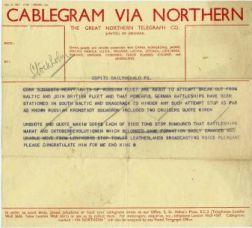
Although never mentioned to his family, invoices found in his archives show that Leatherland gave four short radio talks on the BBC Home Service in 1942-43. It is not clear why he was asked to give these talks but Francis Williams, who served as editor of the Daily Herald from 1936 to 1940, then became Controller, Press Censorship and News, at the Ministry of Information, so he may have suggested Leatherland's name to the BBC.
According to the BBC invoices, he gave the following brief talks on the Radio Newsreel programme which was broadcast on the Home Service :
• A two minute talk “The 18B Debate” on 21 July 1942. (Regulation 18B of the Defence (General) Regulations 1939 was used by the Government during the War to allow the internment of people suspected of being Nazi sympathisers suspending the right of affected individuals to habeas corpus)
• A one and a half minute talk on “Gas Masks” on 31 July 1942
• A two and three-quarter minute talk on “London Invasion Arrangements” on 6 August 1942
• A two and a half minute talk on “Order of Merit” on 1 January 1943. (The Order of Merit recognises distinguished service in the armed forces, science, art, literature, or for the promotion of culture. It was established in 1902 by King Edward VII and admission into the order remains the personal gift of the Sovereign and is restricted to a maximum of twenty four living recipients, plus a limited number of honorary members).
Radio Newsreel was a fifteen-minute BBC news programme which ran at 7 pm each evening between 1940 and 1988. In 1940 it was also broadcast on the BBC Overseas Service in four daily editions six days a week, each one destined for a different region of the world.
Rather than simply recounting the daily news, it deliberately tried to evoke the magazine format of the cinema newsreel, with a slick mixture of recorded dispatches from correspondents in the field, commentary, interviews, and live and recorded actuality, as well as interviews with people currently in the news. Outside the UK, the programme was also carried weekly on the Mutual Broadcasting System in the USA during World War II.
The BBC had been based at Broadcasting House in Portland Place since 1932, but many staff were secretly moved to Wood Norton Hall a country house near Evesham, Worcestershire at the start of the War.
The BBC also began to occupy several blocks in Bush House on Aldwych between 1941 and 1943. Bush House became the heart of the BBC’s international broadcasting network and later the home of the World Service. It is possible that Leatherland’s broadcasts were made at Bush House which was a short walk from the Herald’s Covent Garden offices.

Charles and Mollie with daughter Irene and son John
Religion
Religion does not seem to feature heavily in Leatherland’s adult life, but his reply to a letter from Reverend Wilmot Hickson who lived in Langdon Hills near Dunton sheds sone light on his views. Rev Hickson had written to him seeking his views on the Church of England’s work and role. His letter said that he considered Leatherland to be “an honest intelligent person” who had “a pretty shrewd knowledge of ‘men and movements’.
Leatherland’s reply demonstrated some knowledge of the Church. He praised the work of William Temple, who was Archbishop of York (1929 – 1942) and then Archbishop of Canterbury (1942-1944) and suggested that, before Temple’s appointment “there was a widespread opinion that the Church had drifted away into isolation from the masses of the people” and that “it was viewed by many with suspicion, by others merely by apathy”. Leatherland felt that the Church had annoyed people by “its petty disputes over ritual”.
Leatherland went on to suggest that “the greatest enemy of Christianity has not been the active agitation of atheists, but the passive assumption by millions of people that whereas the Church might have been an inspiring institution in the past, it was now out of date, and that it had no message to give which was in keeping with modern modes of life”.
He did not feel that people were antagonistic to the reception of the Christian message. Millions of people who had been threatened with danger or lost loved ones during the War, had “suddenly relearned how to pray”. He questioned whether the form and phraseology of the message the Church tries to deliver remained appropriate “in the present state of scientific progress, when voices and visions can be conjured out of the ether, when men can fly in the air or walk under the sea, and when we are on the verge of discoveries in atomic research which can (in a physical sense) dissolve old worlds and planets in clouds of fire and, by reversal of the process, create new ones from the residue”.
Leatherland felt that it was important to “get back to Christianity” and that, “as the return to Christianity gathers momentum, temporal expedients can be whittled down”. “It is like adjusting the amounts of petrol and air you take into a carburettor as the engine gathers speed”. He believed that Christianity must be the foundation of politics.
His reply ended with a reference to C.E.M. Joad, a philosopher, author, teacher and broadcasting personality who became a celebrity on the Brains Trust, a BBC Radio wartime discussion programme where he popularised philosophy. Leatherland said that he had known Joad for twenty years, as they were fellow members of the old 1917 Club just after the First World War. “I have known Joad as an atheist, and as a Christian, as a pacifist, and as a war champion ; as a Socialist, then a Communist, then a Socialist again.”
Social Circle 1947
Leatherland compiled a detailed CV in 1947. I am not sure for what purpose, but the CV names many friends and associates who would be willing to provide a reference. These names are useful in giving some idea of his social and political circle in the late 1940s. Here are the names supplied as referees :
Captain Ray Gunter (1909 – 1977) was a Welshman with a background in the railway industry and trade union movement, particularly the Transport Salaried Staffs' Association (TSSA). After service in the Second World War where he reached the rank of Captain, Gunter entered Parliament in the 1945 General Election as Labour MP for the previously Conservative seat of South East Essex. This constituency included Dunton so Gunter would have been well known to Leatherland. He remained a backbench MP during the Attlee governments. A seat redistribution led to the breakup of the South East Essex constituency and he briefly became MP for Doncaster in 1950-51.
Gunter was on with the right wing of the Labour Party and a member of its National Executive Committee from 1955 to 1966. He was re-elected as Labour MP for Southwark in 1959 and then became a member of the shadow cabinet. In 1964 he was appointed Minister of Labour in Harold Wilson’s Cabinet and then briefly Minister for Power in 1968. He resigned from Parliament in 1972.
Arthur Greenwood (1880 – 1954) was a Yorkshireman and prominent Labour politician from the 1920s until the late 1940s. He became Secretary of the Labour Party Research Department in 1920 and Labour MP for Nelson and Colne in 1922, serving as Parliamentary Secretary to the Ministry of Health in the short-lived Labour government of 1924. He was Minister of Health (1929-1931) when he raised widows' pensions and encouraged large-scale slum clearance through the Housing Act 1930. He was defeated in the 1931 election, but returned to Parliament the following year as MP for Wakefield where he continued to serve until his death in 1954.
Greenwood was Deputy Labour Party Leader from 1935 under Clement Attlee, and he remained in this post for ten years. When the wartime coalition government was formed, Churchill appointed him to the War Cabinet as Minister without Portfolio. He resigned in 1943 but became Labour Party Treasurer. Until the end of World War II, Greenwood also acted as Leader of the Opposition. During the 1945-51 Attlee government, he served successively as Lord Privy Seal and Paymaster-General.
Lord Charles Latham (1888–1970) was Leader of the London County Council (LCC) from 1940 to 1947. He became a County Alderman in 1928 which brought him into close contact with Herbert Morrison who was Labour Leader on the LCC and Minister of Transport in the Labour government from 1929. In the 1934 election Latham became a Councillor in Hackney and Chair of the Finance Committee. In 1942 he was created a life peer.
When Herbert Morrison was appointed to the Government in the wartime Coalition, he chose Latham as his successor as London County Council Leader. Wartime circumstances made the civil defence of London a top priority for the council, and normal party politics were suspended. The council had a large share of the responsibility for Air Raid Precautions (it ran the Fire Service and the Ambulance Service) and it was the biggest hospital authority in the country. Latham became Chairman of the Civil Defence Committee.
Latham instigated a Labour Party inquiry into the structure of post-war London government, which was an attempt to examine his preferred policy of creating a Greater London Authority covering a much wider area, which was a highly controversial policy within the Party. This may be how Latham became acquainted with Leatherland.
Lord Strabolgi (1886–1953). The Strabolgi baronetcy is hereditary and dates back to the 14th century. The 10th Baron Strabolgi was a former Naval officer who became a Liberal MP in 1919 but joined Labour in 1926. In 1934, he succeeded his father to the baronetcy and became opposition chief whip in the House of Lords (1938 – 1942). During the Second World War, he wrote numerous articles on the war, especially the war at sea. It is not clear how he knew Leatherland.
Glenvil Hall (1887–1962) was a barrister and Labour MP, first elected in 1929. From 1939 to 1962 he was MP for Colne Valley. In the 1945-50 Labour Government he served as Financial Secretary to the Treasury. After leaving government in 1950, he served as chair of the Parliamentary Labour Party's liaison committee. It is not clear how Leatherland knew him.
Reginald Windle was Chief National Agent at Labour Party Head Office in 1947.
Wilfred Young was Labour Eastern Regional Organiser. Leatherland was heavily involved with the Eastern Region.
STARLING CLOSE, BUCKHURST HILL
In the late 1940s, Mollie Leatherland became ill, and her doctor recommended moving to a smaller house. They found a nice house on the edge of Epping Forest in Starling Close, Buckhurst Hill, on the Essex borders of north-east London. They remained there for the rest of their lives.

Starling Close, Buckhurst Hill