MACCLESFIELD COURIER

Leatherland (top centre) with two of his brothers and their wives (c1930)
In 1921 Leatherland moved to Macclesfield, Cheshire renting a council house in Brocklehurst Avenue. A year later he married Mollie Morgan, who came from Shareshill, Staffordshire. In 1923 they had their first child, a daughter, Irene.

Brocklehurst Avenue, Macclesfield where daughter Irene was born in 1923
Leatherland moved to Macclesfield because he had a new job, his first full time post as a journalist. He was Chief Reporter and Sub-Editor on a local newspaper, the Macclesfield Courier.
The Macclesfield Courier & Herald was a well-established local paper founded in 1828. The British Library holds issues of the Macclesfield Courier from 1828 to 1952 although so far only a few years have been digitised online at the British Newspaper Archive.

Wedding of Charles Leatherland and Mary Morgan 1922
Freelance Journalism
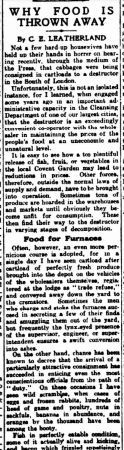
Article by Leatherland in the Daily Herald - Sept 1922
In the early 1920s Leatherland wrote a considerable number of articles and short stories for newspapers and magazines on a freelance basis. Here are some examples from his cuttings file. This table gives the date, title, content and publication in which it appeared.
|
6 June 1921 |
“Golf for the Worker” |
Article |
Daily Herald |
|
17 June 1921
|
“A Ministry of Memory - or HM Office of Anti-Forgetfulness”. |
Sarcastic article |
Cotton Factory Times |
|
1 July 1922
|
“Are Women Coerced – Or Men ?” |
A slightly tongue in cheek article recounting tales of various court cases in which women appeared to have the upper hand over men. |
Weekly Telegraph |
|
5 May 1922 |
“Should Socialists be Buffs?” |
Article on Secret Societies. Buffs” were members of the Royal Antediluvian Order of Buffaloes, a fraternal organisation with some similarity to Freemasonry but without the secrecy |
Cotton Factory Times |
|
13 Jul 1922 |
“Doped” |
Short story |
Weekly Telegraph |
|
24 Aug 1922 |
“Sea Bathing Safety" |
Article |
Daily Herald |
|
29 Aug 1922 |
“A Cat-Astrophe” |
Short story |
The Co-operative News |
|
5 Sept 1922
|
“Why Food is Thrown Away” |
Article |
Daily Herald |
|
16 Sept 1922 |
“Identity Discs” |
Article |
Weekly Telegraph |
|
27 Sept 1922 |
Municipal Taxis” |
Article |
Daily Herald |
|
7 Oct 1922 |
“A Tale of Time & One Who Had to Do it” |
Short story |
Weekly Telegraph |
|
23 Oct 1922 |
“The Dustman’s Daily Job” |
Article |
Daily Herald |
|
4 Mar 1923 |
“The Passing of the Dustbin” |
Article |
Daily Herald |
|
26 April 1923 |
“Exploitation : A Suggestion for Provincial Exhibitors” |
Article |
The Cinema |
|
June 1923 |
“The Golf Caddie” |
Short story / article |
Royal Magazine |
|
20 July 1923 |
“Blazers and Blazes : Fashion’s Evolution” |
Short story |
Cotton Factory Times |
SHATWELL FAMILY
While working in Macclesfield, Leatherland lived as a lodger at 31 Clowes Street with Marcus and Kate Shatwell. The Shatwells had an eight year old daughter Kathleen (known as Kay) who became a lifelong friend. The 1921 Census, the Electoral Register (1922) and his marriage certificate (1922) all show him living at 31 Clowes Street with the Shatwell family.
The 1921 Census shows that Marcus Shatwell was 45 years old. He was born in Macclesfield and worked as Chief Clerk in the Goods department of the Great Central & North Staffordshire Railway. His wife Katherine was a 42-year-old housekeeper. Their daughter Kay was a seven year old schoolgirl. Kay later married a wealthy Swiss businessman, Werner Schmidt, and they settled in Switzerland.
MACCLESFIELD COURIER

In the 1921 Census Leatherland stated that his employer was Robert Brown, a newspaper proprietor, and his place of work was the Courier office, Macclesfield.
Leatherland soon became a distinctive figure at the Courier. According to my mother, the editor was often away, and Leatherland was left to run the paper, which gave him a good grounding in journalism.
Robert Brown may have often been away because he was quite elderly. But he was also a very experienced journalist. The Lichfield Mercury (6th May 1921) reported that Mr R Brown, Proprietor of the Macclesfield Courier, celebrated his jubilee at a dinner having joined the paper as a reporter in 1871. The 1911 Census for Macclesfield shows that Brown was born in 1852 in Dundee, so he was 69 years old when Leatherland joined the paper.
In an article in the Macclesfield Express in 1964 when Leatherland was given his peerage, a former colleague on the Courier, Clifford Rathbone, shared his vivid memories of working with him :
"With his thick mop of red hair he was a familiar figure in Macclesfield district ... he would return from a meeting and with a packet of mint creams on one side and Turkish cigarettes on the other, he would set to work and simply pour out his copy"
Clifford Rathbone - who in 1964 was still working as a journalist in Macclesfield - also wrote to Leatherland in 1972 having read about a speech he made in the House of Lords. His letter conjures up some of the atmosphere of those times :
Dear Lord Leatherland.
Reading your speech in support of Lord Vernon's motion to keep Poynton in Cheshire, brought back many happy memories, especially when you talk about reporting the meetings of the Macclesfield Rural District Council, which in those days were in the Board room at the old Workhouse in Prestbury Road.
You will have forgotten the young boy, Clifford Rathbone at the Courier who you used to send out to Twemlow's in Chestergate for your Turkish cigarettes and peppermint creams. That was in the good old days of Bob Brown, the editor of the Courier. I shall never forget the early training I received under your good self. You once told me to go to a meeting of the Band of Hope and I recall saying that it would be a waste of time for there would be no news in such a meeting and you replied : ‘No matter what the meeting, or the event, any journalist worth his salt will be able to find a story’. When I handed in my copy, you replied ‘What did I tell you?’. I have often used that story to young reporters.
Remember the day when you left Macclesfield and the Salvation Army was asked to collect the old magazines etc from your house at Hurdsfield. What a pile they had. You seemed to read everything in those days. I can still see you standing at the counter of WH Smiths in the Market Place reading the magazines. I used to envy the respect people had for you. Then came that proud day in the Courier office when you won two medals in an international essay writing competition."
Film Lyricist
According to publicity material found in his cuttings archive, one of Leatherland’s more unusual jobs was writing the lyrics for the prologue to a silent film "The Loves of a Pharaoh” which was shown at the Macclesfield Premier Picture House.
The Loves of a Pharaoh was directed by German born Ernst Lubitsch who moved to Hollywood shortly after the film’s release. It was an historical epic, filmed in Germany with the story being set in Ethiopia and allegedly using 100,000 extras !!
Like many silent films, it was largely forgotten until a highly damaged copy was discovered in Moscow in 1970. The film was restored and re-released in 2011. Quite how Leatherland came to write lyrics for Macclesfield Picture House’s showing of the film is not known.
1977 Memories of Macclesfield
In a House of Lords debate on the Administration of Justice Bill in 1977 Leatherland recalled his days in Macclesfield :
“I must confess that I felt staggered, albeit rather mildly, when I learned from Clause 19, in association with the Schedule on page 28, that the ancient Macclesfield Court of Portmote is to be abolished so far as its judicial functions are concerned. I thought to myself, "Are they trying to tamper with the history of a town I love?"—for anybody who has lived in Macclesfield has learnt to love it. It is a place where everybody knows everybody else and where nearly everybody greets his neighbour by his Christian name."
"I spent four of the happiest years of my life in Macclesfield. I went there about 55 years ago to join the editorial staff of the old Macclesfield Courier, one of those local newspapers which were founded in the days of the Battle of Waterloo. I found the people were proud of their town and that the mayor on formal occasions, would always refer to it as this "loyal and ancient borough".
"I had much to do with the courts in that district. Three times a week I was reporting the borough magistrates' court; once a fortnight the county magistrates' court; and once a month the county court under that eminent Judge Ruegg, perhaps the greatest expert on rents that the law in this country has ever seen. Every quarter, I would be at Knutsford quarter sessions and from time to time at the Chester Assizes if there were any malefactors from Macclesfield who happened to be appearing there.”
According to a Macclesfield newspaper cutting from the 1940s, Leatherland was a member of the Hurdsfield Golf Club when he lived in Macclesfield. Higher Hurdsfield was a village on the eastern outskirts of Macclesfield. Its Golf Club was founded in 1900.
Marriage to Mollie Morgan
Mary Morgan (known as Mollie) was the daughter of a coal miner, Joseph Morgan. She grew up in the village of Shareshill, Staffordshire. Her mother died of tuberculosis when Molly was seventeen years old.
The 1921 Census shows Molly had moved to Macclesfield where she working as a general domestic servant. She was living at Mount Pleasant, Macclesfield, in the household of George Ellinger, a 58 year old branch manager at H T Gaddum & Co Manchester, raw silk merchants.
According to the census Mount Pleasant was a house with eight rooms. A modern property advert describes Mount Pleasant as “A stunning Grade II listed early Victorian Residence, offering substantial well appointed accommodation to include five bedrooms, three bathrooms, three reception rooms, plus cellars pretty gardens and a detached double garage”, although the British Listed Buildings website describes it was a terrace of eight houses, now divided as flats.
George Ellinger’s employer, H T Gaddum & Co, had been trading since 1826 and was only wound up in 2016. An offshoot, Gaddum & Gaddum, is still trading as specialists in yarns, fibres and fabrics based in Leek, Staffordshire.
Leatherland’s boss Robert Brown has not been found in Macclesfield at the time of the 1921 Census, but the local Electoral Register of 1921 shows that Brown and his wife Clara were also living at Mount Pleasant. They were also there in the 1911 Census. Because his Editor was living in the same property as Molly Morgan, it seems likely that this is where Charles and Molly first met perhaps while he was visiting his editor’s home.
In July 1922 Charles and Mollie got married at St Michael’s Church, Macclesfield. Charles was twenty four, Mollie was twenty three. The witnesses on the marriage register were Charles’ brothers, Will and John, and Marcus Shatwell.
Following their marriage, Charles and Mollie moved to a council house in Brocklehurst Avenue, where their daughter Irene was born in July 1923.
Gold Medals for Essays
In 1923 and 1924 Leatherland found success in English Essay Competitions organised by the Commercial Education Department of the London Chamber of Commerce.
In the 1923 English Essay Competition, Leatherland won a commendation for his essay on “The possibilities of the cinema in connection with education”.
In 1924 he won the Gold Medal in the Colonel and Alderman Sir Charles C Wakefield Bart Medals competition for an essay on “The difficulties attending the economic position of Czecho-Slovakia after the peace treaty, and the methods adopted to remove them”.
Leatherland also won the Gold Medal in the Joseph Travers & Sons Ltd Medal competition for his essay on “Home and foreign trade. Their relative importance and inter-dependence”.
There was an award ceremony at the Mansion House in March 1925. Leatherland was the only candidate to win two gold medals. They were presented to him by the Prince of Wales. A news report (probably in the Macclesfield Courier) said that the competition attracted economic and literary aspirants from all over the world :
“Mr Leatherland was warmly applauded when the two medals were handed to him by his Royal Highness, especially as he alone out of the successful candidates had obtained a double first award. The Prince displayed a very great interest in the achievement and asked Mr Leatherland at what college and under whose tutorship he had conducted his studies. On learning that the recipient had studied at home and taught himself, His Royal Highness remarked that this factor made the double success more creditable still. At the conclusion of the ceremony Mr Leatherland was personally congratulated by many more members of the assembly, several of whom commented especially upon the particularly intricate and difficult nature of the Czecho-Slovakian Essay.”
There are copies of the winning essays on the cinema and home and foreign trade in his papers, although I can only find draft notes for the Czechoslovakian essay. The cinema essay is perhaps the more interesting one – although it only received a commendation rather than a medal.
National Union of Journalists
A newspaper cutting from 1950 said that Leatherland joined the NUJ at Manchester in 1920. He transferred to the NUJ Parliamentary Branch in 1924 and then to the Central London Branch in 1930. He was a delegate from Manchester and Parliamentary to several annual delegate meetings.
Macclesfield Labour Party
Leatherland was active in the local Labour Party. He acted as unpaid secretary to the Labour candidate Andrew Penston at the 1922 and 1923 general elections. The Macclesfield constituency had been a Liberal Party seat until 1918 when the Conservatives won the seat.
Return to Macclesfield in the 1940s
In the early years of World War Two, Mollie Leatherland and the two children Irene and John, moved to Macclesfield, as Charles felt that Dunton was at risk of German bombing.
In 1924 Leatherland moved to London to work at Labour Party Head Office. This coincided with the first ever Labour Government.

King Edward Street. Macclesfield - the Courier's offices were in one of these buildings


Charles Leatherland (1920s)